Barium Titanate (BTO) is gaining strong momentum in integrated photonics due to its exceptional electro‑optic performance, energy efficiency, and growing manufacturability within semiconductor ecosystems.
- Large Pockels Coefficient:
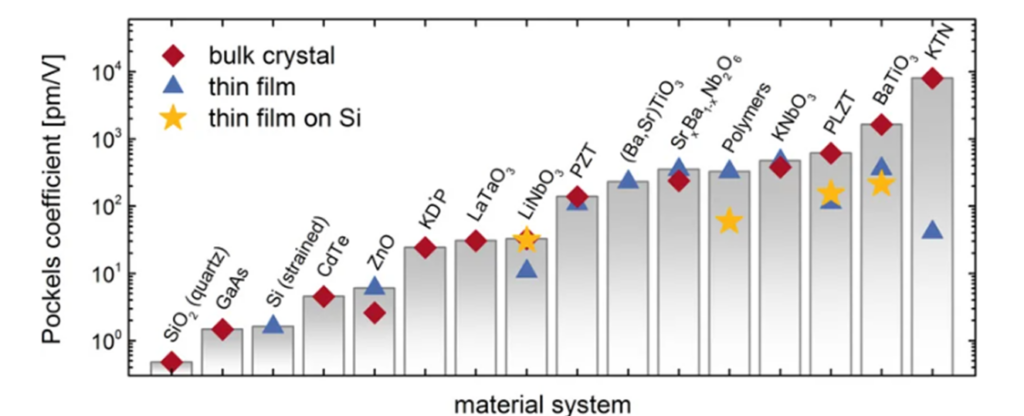
BTO exhibits a very high linear electro‑optic (Pockels) coefficient—significantly larger than traditional materials such as lithium niobate or silicon-based approaches. This enables strong light–matter interaction and efficient phase modulation over short device lengths, making it highly attractive for compact, high-speed photonic components. - Energy Efficiency:
The strong Pockels effect translates directly into low drive voltages (low Vπ) and reduced power consumption. This allows BTO-based modulators to operate with substantially improved energy efficiency, which is critical for scaling optical interconnects in data centers, AI hardware, and communication systems. - Foundry Compatibility:
BTO can be integrated onto silicon using thin-film deposition and heteroepitaxial growth techniques, aligning with existing CMOS-compatible fabrication processes. This compatibility lowers the barrier to adoption by enabling co-integration with established silicon photonics platforms and leveraging mature semiconductor manufacturing infrastructure. - Scalability and Manufacturing Readiness:
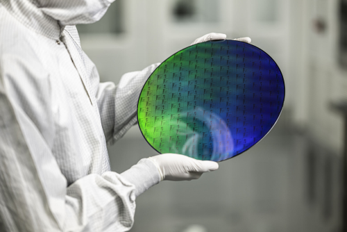
Advances in thin-film growth, wafer bonding, and process uniformity now enable wafer-scale fabrication of high-quality BTO films, supporting repeatable, high-yield device production. These developments mark a transition from research demonstrations to manufacturable technology. - DCA as a Leader with Demonstrated Results:
DCA Instruments has established leadership by delivering precision deposition tools and epitaxy solutions that enable high-quality BTO thin films with reproducible properties. Demonstrated results in device-grade material quality, uniformity, and integration readiness position DCA as a key enabler for scaling BTO photonics into commercial platforms.
–
In summary, BTO combines superior electro-optic performance with improving manufacturability and ecosystem alignment, making it a compelling next-generation material for energy-efficient, high-performance integrated photonics.